Pharma United provides cutting-edge BIM (Building Information Modeling) design services for pharmaceutical cleanrooms, delivering detailed 3D models and comprehensive construction documentation.
Product details
Pharma United provides cutting-edge BIM (Building Information Modeling) design services for pharmaceutical cleanrooms, delivering detailed 3D models and comprehensive construction documentation. Our BIM approach ensures precise coordination of architectural, structural, HVAC, electrical, and plumbing systems, minimizing design conflicts and construction risks. Clients benefit from enhanced visualization, streamlined project management, and accurate cost estimation, enabling informed decisions throughout the project lifecycle.
By integrating GMP-compliant design standards, our solutions guarantee that every cleanroom is engineered for operational efficiency, safety, and regulatory compliance. Leveraging our expertise, pharmaceutical companies can confidently execute turnkey projects with reduced risk, shorter timelines, and optimized performance, achieving world-class cleanroom facilities from concept to completion.
Modern pharmaceutical manufacturing requires highly precise and compliant environments. Cleanroom BIM design plays a critical role in ensuring that cleanroom facilities meet strict regulatory standards while maintaining operational efficiency.
At Pharma United, we provide advanced cleanroom design and Cleanroom BIM design services tailored for pharmaceutical and life science facilities. By using Building Information Modeling (BIM), we create detailed digital models that integrate architectural, structural, and engineering systems into a unified design platform. This approach improves design accuracy, enhances collaboration, and reduces construction risks throughout the project lifecycle.
Our BIM-based cleanroom design and build approach allows clients to visualize their facilities before construction begins. This leads to better decision-making, smoother project execution, and more predictable outcomes.
Cleanroom BIM design refers to the use of Building Information Modeling technology to plan, coordinate, and manage cleanroom construction projects. Unlike traditional 2D design methods, BIM creates an intelligent 3D model that includes all major building systems.
This model integrates:
By combining these systems into one coordinated model, BIM helps eliminate conflicts between different engineering disciplines. This is especially important in pharmaceutical cleanrooms where space constraints and system interactions can significantly impact performance and compliance.
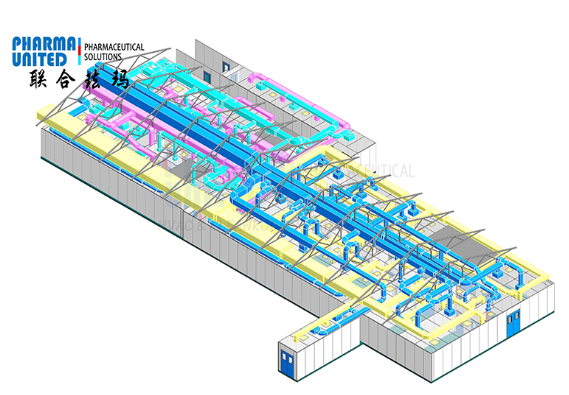
BIM technology enables engineers to simulate the entire cleanroom environment before construction begins. This ensures that the cleanroom design meets all technical and regulatory requirements.
Key benefits include:
One of the most critical components of pharmaceutical facilities is cleanroom HVAC design. Airflow, filtration, pressure control, and temperature management must all meet strict GMP standards.
With BIM modeling, engineers can accurately design and coordinate HVAC systems to ensure:
This integrated cleanroom HVAC design approach improves both operational efficiency and regulatory compliance.
BIM allows architects, engineers, contractors, and facility managers to work from the same digital model. This collaborative environment improves communication and minimizes costly design changes during construction.
For companies implementing cleanroom design and build projects, BIM ensures that every stakeholder has access to the latest design information.
Benefits include:
A successful cleanroom design and build project requires seamless integration between design and construction teams. BIM technology bridges this gap by providing a digital blueprint that guides the entire project.
Through BIM-based cleanroom design, project teams can:
This integrated workflow significantly reduces project risks and helps ensure that pharmaceutical facilities are delivered on schedule and within budget.
Pharmaceutical manufacturing environments must comply with strict regulatory standards such as GMP guidelines. Our cleanroom design services incorporate these standards from the earliest planning stages.
Our design process ensures compliance with:
By integrating compliance into the Cleanroom BIM design, pharmaceutical companies can achieve high-performance facilities that meet global regulatory expectations.
Our cleanroom design and build solutions are widely used across multiple pharmaceutical and life science sectors, including:
These environments require advanced cleanroom HVAC design and precise contamination control, which BIM modeling helps achieve efficiently.
Beyond BIM modeling, our team provides a complete cleanroom solution covering the entire project lifecycle. From conceptual planning to final construction documentation, every stage is designed to maximize efficiency and compliance.
Our services include:
This comprehensive approach ensures that pharmaceutical companies receive a reliable and future-ready cleanroom facility.
Choosing the right partner is essential for successful pharmaceutical facility projects. With extensive experience in cleanroom design and BIM technology, our team provides reliable engineering solutions tailored to industry requirements.
Key advantages include:
Our goal is to help pharmaceutical companies build high-performance cleanroom environments that support safe production and long-term operational success.

As pharmaceutical manufacturing becomes more complex, traditional design methods are no longer sufficient. Cleanroom BIM design offers a smarter and more efficient way to plan and construct modern cleanroom facilities.
By integrating cleanroom design, cleanroom HVAC design, and advanced BIM coordination, companies can reduce project risks, improve construction efficiency, and achieve regulatory compliance with confidence.
With the right cleanroom design and build strategy, pharmaceutical manufacturers can develop world-class facilities that support innovation, productivity, and quality.
A cleanroom design is the planning and engineering of a controlled environment where contamination is minimized. It ensures proper airflow, filtration, and layout to meet regulatory standards, and often integrates Cleanroom BIM design for precise modeling and coordination of architecture, HVAC, and other systems.
To create a cleanroom, start by defining the required cleanliness level and workflow, then plan the layout and implement a cleanroom HVAC design to control air quality, pressure, and temperature. Materials, equipment, and surfaces should minimize particle shedding, and using BIM-based cleanroom design can help optimize construction and coordination.
The 5S methodology in a cleanroom includes Sort, Set in order, Shine, Standardize, and Sustain. Applying these practices ensures organized workflows, reduces contamination risks, and supports compliance with cleanroom standards, enhancing the effectiveness of any cleanroom solution.
Related Projects
Guangzhou Ocean University Research Institute
Guangzhou Ocean University Research cleanroom project was finished in 2026 at Guangzhou, China.
Zhejiang, China Pharmaceutical Cleanroom Project
Explore a 2,000㎡ cleanroom project by Pharma United in Zhejiang, China, featuring sandwich panels and PGCI steel doors for pharmaceutical production compliance.
Center for Disease Control, located in China, is a major public health facility project with a total construction area of approximately 20,000 square meters.
Looking for Supplier?
Let's discuss your upcoming cleanroom project. Our engineering team is ready to provide support from design to validation, ensuring a seamless process.
Discuss Your Project
Leave Your Message

Pharma United Co., Ltd.
Pharma United Co., Ltd.
Tel.: +86 177 1554 8238
Add.: NO.58 Beiyuan Road, Dianshanhu, Kunshan, Jiangsu, China, ZIP code 215345
Navigation
Navigation